Mergers & Acquisitions
-
“What happens when one company buys another on the stock market at the time of purchase or at the time of voluntary sale? Such operations are frequent in the merger and acquisition phase of the economy. Sometimes public regulations also stimulate them. However, to understand what changes the operation brings, first, we need to explore…
-
The market views divestment positively as an event, even though management usually avoids such decisions. However, divestment does not always create value and can sometimes result in negative outcomes. According to McKinsey’s research, the speed of the process is particularly important. For example, in cases where the process was completed within six months, the excess…
-
Mergers and acquisitions can be executed either with cash or by transferring the shares of the new company. What is the difference? When the acquisition is done with cash, the entire risk of the transaction is borne by the shareholders of the acquiring company. In the case of an acquisition with shares, the risk of…
-
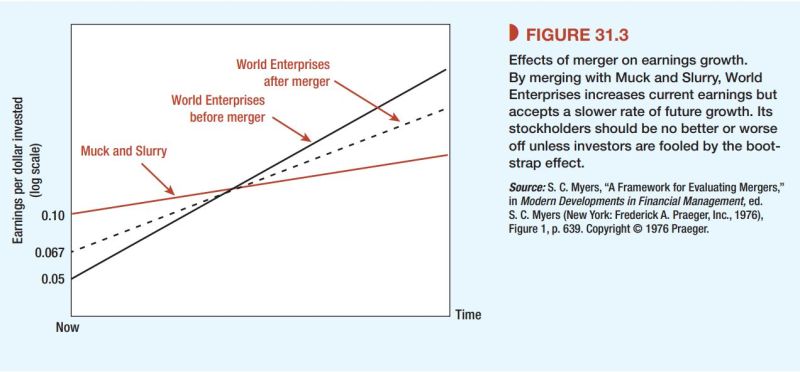
Managers often justify mergers and acquisitions by claiming that the operation is accretive, meaning that EPS (earnings per share) increases, and therefore shareholders should be satisfied. However, the market focuses not on transactional accounting but on whether value is actually being created. The table below discusses a hypothetical example that shows the deterioration of an…
-
According to McKinsey’s research (1999-2013, 1770 transactions), the combined value of the acquiring and acquired organizations increased by an average of 5.8% as a result of acquisitions. In 95% of acquisitions, the value of the acquired organizations represents less than 5% of the acquirer’s capitalization. Generally, synergy achieved through mergers and acquisitions is difficult to…
-
“When a management team with a reputation for brilliance tackles a business with a reputation for bad economics, it is the reputation of the business that remains intact.” – Warren Buffett Is it worthwhile for an organization to invest in non-correlated businesses for the sake of risk diversification? As shown in the graph, this is…
-

It’s a widely spread misconception when investors believe that purchasing a company with a high P/E ratio from a company with a low P/E ratio automatically corrects both ratios to the higher one and not the average…