Derivatives

  • Ito’s Lemma in Forwards

    To describe the evolution of a derivative of stock price, we use Ito’s Lemma. For example, through it we can express the fair forward price of a stock as a derivative of its current spot price. Recall that the Ito process is a generalized form of the Wiener process, where both the drift rate and…

    Read more →

  • A common model for the price movement process of non-dividend-paying stocks is the Geometric Brownian Motion (Robert Brown (1773–1858) was a Scottish botanist). Initially, Brown observed that dust particles suspended in water moved in a jittery, random manner. Later, Einstein explained that this was caused by molecular collisions, Wiener provided the mathematical formulation, and Itô…

    Read more →

  • Without the discoveries of the Japanese mathematician Kiyoshi Itô (伊藤 清, 1915–2008), the Black–Scholes–Merton model — and therefore the modern derivatives market — could not exist. Before moving on to Itô’s discovery, it’s helpful to understand the generalized Wiener process, and even before that, to get clear on the Markov and Wiener processes (you can…

    Read more →

  • Wiener Process

    Wiener Process

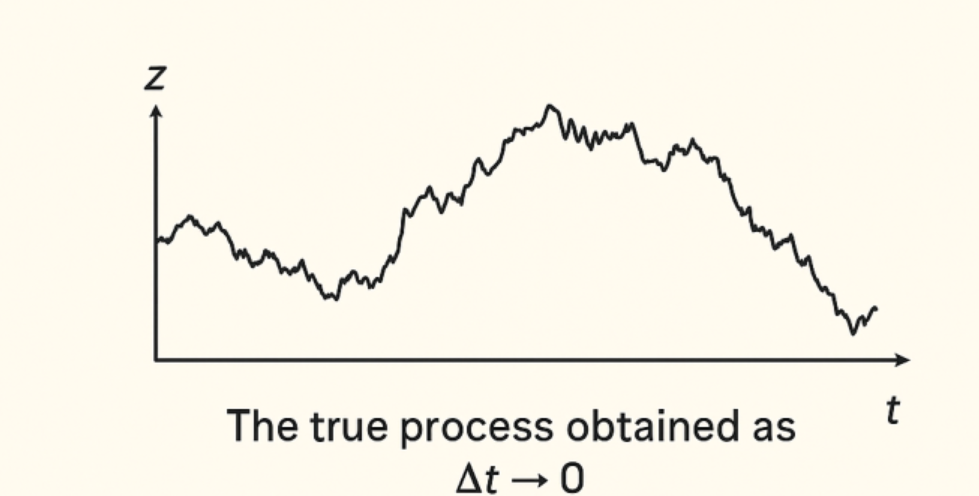
    If physicists use the Wiener process to describe the movement of molecules, for finance it is interesting because it helps us understand the price behavior of stocks and derivatives. A Wiener process is a specific version of a Markov stochastic process in which the expected value of the change is zero and the variance is…

    Read more →

  • Markov Process

    Markov Process

    Why is uncertainty considered proportional to the square root of time (√t)? A Markov process (named after the Russian mathematician Andrey Markov (1856–1922)) is a special case of a stochastic process where, to predict a variable’s future value, only its current value matters. The past has no influence on the probability of future outcomes. The…

    Read more →

  • How Randomness Shapes Markets

    🎲 Have you ever noticed how life, business, and markets share one thing in common — uncertainty? Finance doesn’t ignore that; it embraces it.John Hull’s classic work on derivatives explains how we can actually model uncertainty — and that’s what this post is about. Let’s walk through it in plain words 👇 🌧️ 1. Stochastic…

    Read more →

  • Risk-Neutral vs Replication in Option Pricing

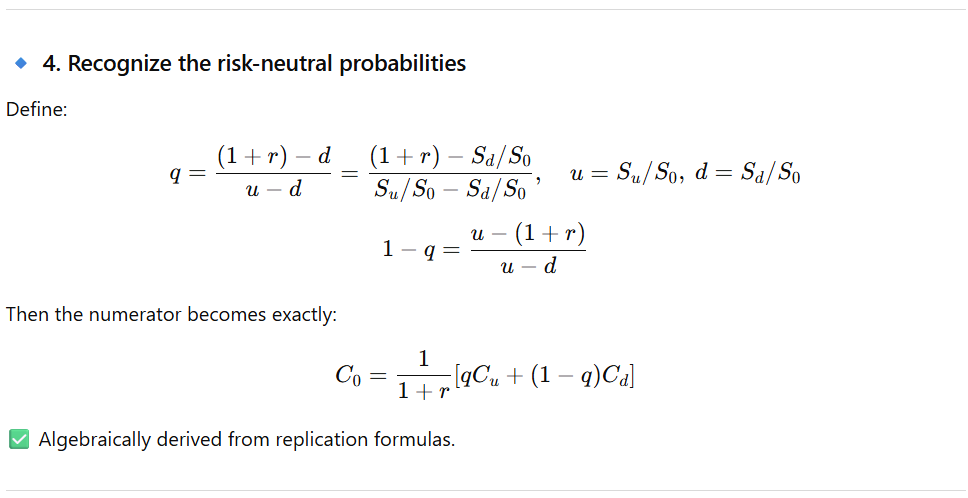
    Using the Risk-Neutral Probability Method in Option Valuation is a bit counterintuitive. Why doesn’t the option price depend on the expected movement of the underlying stock — its probability of going up or down? Why does it not matter if the probability of the stock going up is 95% or 15%? Why do calculations done…

    Read more →