Business Value
Explores the foundations of business value. Focuses on what makes a business strong, durable, and capable of creating returns over time.
-
The value formula from Valuation: Measuring and Managing the Value of Companies by McKinsey & Company (also referred to as the Tao of Corporate Finance) is: Where: At first glance, it looks like just another finance formula. It is not.This one quietly tells you almost everything that matters: profitability, reinvestment, growth, and capital discipline. Not…
-

How should WACC be calculated when the capital structure includes convertible bonds? The value of a convertible bond is split into two components: The value of the conversion option is calculated using the standard call option pricing formula: See also: Valuation of Employment Compensation with Options and Grants P.S.The chart shows how convertible bonds trade…
-

Below is a chart showing how dramatically a company’s equity beta can change with the expiration of derivative securities: Source: Corporate Valuation: Theory, Evidence and PracticeMark E. Zmijewski; Robert W. Holthausen Key points: 📌 Conclusion:These formulas emphasize that when valuing equity, it is crucial to account for the weight of derivative instruments. In some cases,…
-

Compensation through options and shares, as well as the issuance of similar warrants to external parties, represents a regular source of financing for an organization. Therefore, in valuation, it is necessary to account for them within the capital structure: P.S.Employee stock options differ in substance from warrants and regular options in that they do not…
-

While Valuation, Excess assets should be separated from core operations and valued separately, but here it is important to see what effect this separation has on the right-hand side of the balance sheet when measured at market value… Does the removal of excess assets reduce debt, preferred stock, common equity, or other claims? The point…
-

In some cases, when valuing an organization, using the WACC method for discounting cash flows can be misleading, and it is better to use the APV method.To understand this, it is useful to look at the modified form of WACC, where it appears as a function of the value of the Interest Tax Shield (ITS).…
-
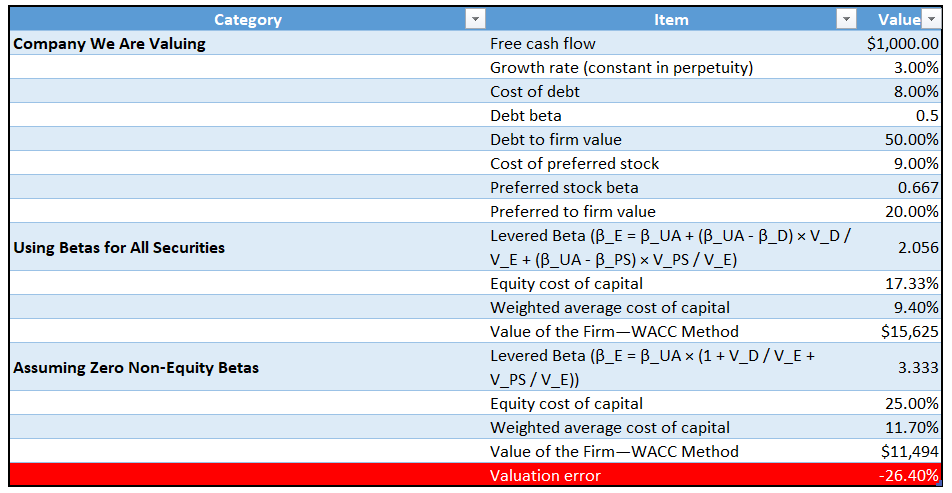
The table presents an example illustrating a widespread and significant error in valuation, related to the assumption of ignoring the beta coefficient of debt or other non-equity sources of financing—in this example, the error amounts to 38%. Source: Corporate Valuation: Theory, Evidence, and Practice, Mark E. Zmijewski; Robert W. Holthausen A common practical mistake is…