ROIC (Return on Invested Capital) is the most effective metric for evaluating a company’s competitiveness and for selecting investments.
Business is such that high-profit margins are not necessarily a sufficient condition for evaluating an organization’s competitiveness. It is possible for the quality of asset utilization to be very low, and high operational profit margins only create an illusion of success.
ROIC shows how efficiently an organization uses the assets involved in its operations.
Formula:
ROIC = NOPAT / (Fixed Assets + Working Capital)
Where,
- NOPAT – Net Operational Profit After Tax – operational profit reduced by taxes, but not by interest expenses;
- In the denominator, total assets are given, including cash and its equivalents. These are the assets involved in operations.
Why is it a critical metric:
When an organization grows, it reinvests profits entirely or partially in growth. When sales grow, assets also proportionally increase, and financing this growth becomes necessary. Here we highlight two important moments:
- ROIC vs WACC – If ROIC is lower than the cost of capital, it means management destroys capital with growth, which is not in the interest of shareholders. To ensure the growth rate is discounted, the minimum ROIC should exceed the WACC. If not, it’s better to reduce the growth rate and distribute dividends. The difference between ROIC and WACC represents the value management creates.
- ROIC defines the sustainable growth rate. For example, if ROIC is 10%, and the organization’s growth rate is 15%, it means the organization needs a 150% increase in profit (15%/10%) to finance this growth. Thus, when defining the optimal and maximum leverage ratio, if the organization matches debt with the optimal and moderate leverage ratio – D/E = 50%, it won’t compromise leverage. But if D/E < 50%, then the sustainable growth rate, the metric, shows whether it can maintain long-term growth…
Specific numbers from research:
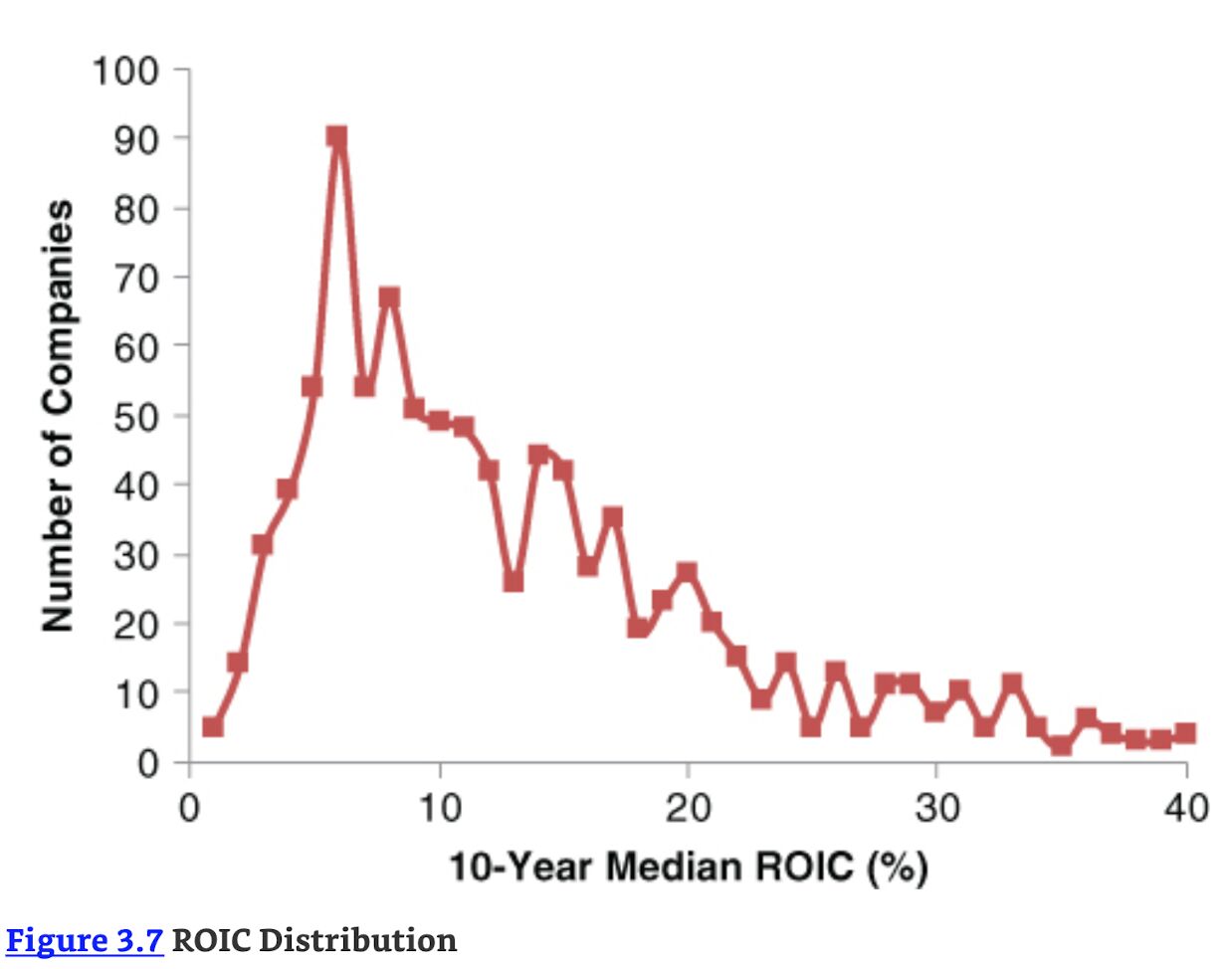
The histogram below shows the distribution of 1045 organizations’ 10-year median ROIC. The peak is at 6%. Only 20% of organizations manage to maintain a median ROIC of 20% or more over a long period.
Graph from the book:
“Invest Like a Guru” by Charlie Tian; Chapter 3.