Centripetal and Centrifugal Forces in Urban Development
Centripetal Forces:
- Economies of Scale:
Economies of scale arise when large-scale production reduces the per-unit cost. For instance, producing 1,000 cars in one city is more cost-effective than producing 500 cars each in two cities. - Economies of Agglomeration:
Agglomeration refers to the economic benefits derived from the proximity of interconnected industries, either vertically or horizontally. For example, locating a tire factory near automobile manufacturers creates cost efficiencies. - Positive Location Effects:
These involve indirect influences. For instance, large-scale real estate construction positively impacts the sale of household appliances.
Centrifugal Forces:
Centrifugal forces involve the challenges posed by urban growth, such as traffic congestion, air quality issues, and noise, as well as increased transportation costs between urban and rural areas.
For example, in a country with 100 million people, there could either be 100 cities of 1 million each or 10 megacities. However, megacities lead to higher transportation costs for agricultural goods. Theoretically, optimal distances and city sizes exist to balance these factors.
Central Place Theory (CPT):
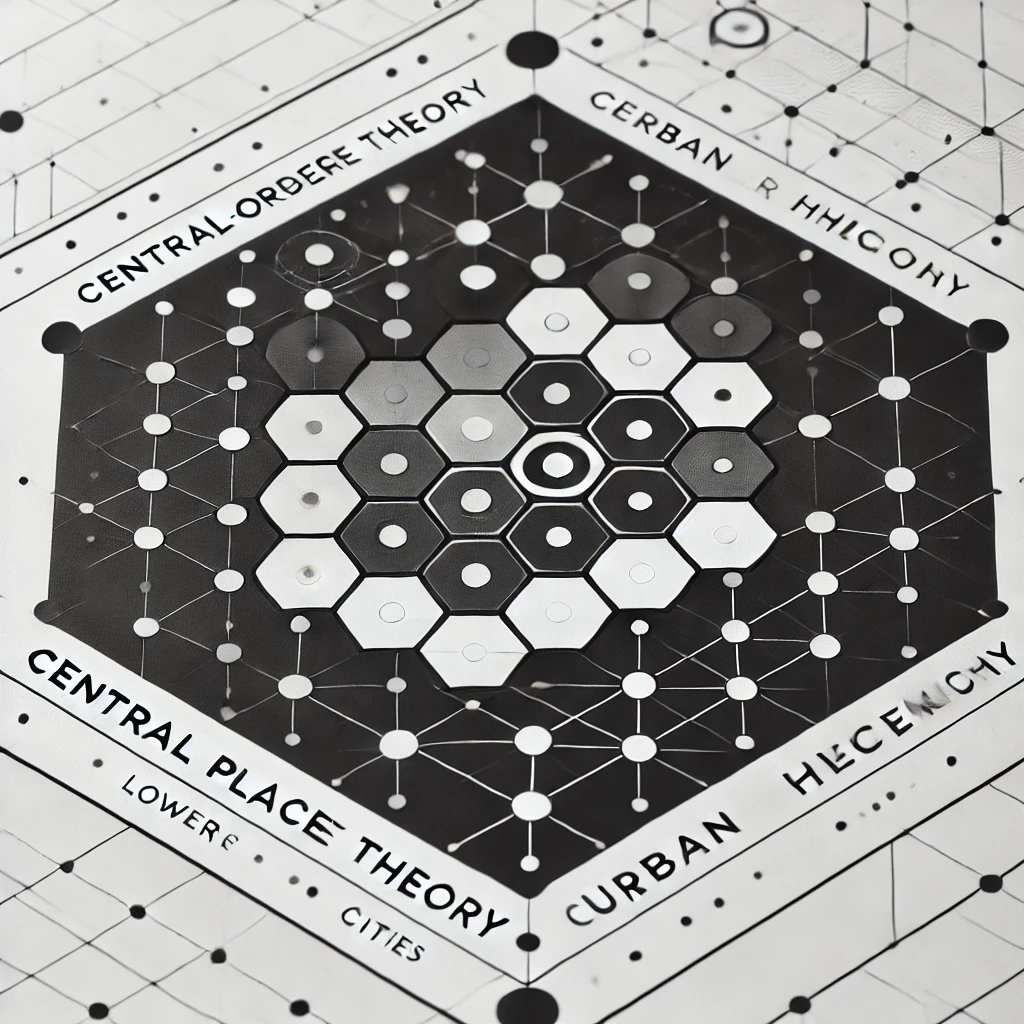
Based on these ideas, the Central Place Theory (CPT) emerged, including the theory of urban hierarchies.
German geographer August Lösch developed CPT. He proposed that the interdependence between urban services and agricultural products leads to the formation of equally spaced, equally sized cities.
He demonstrated that, under equal conditions, these cities should be located at the centers of equilateral hexagons. This placement optimizes transportation costs and ensures full service coverage of agricultural land.
Later, German geographer Walter Christaller advanced the theory, noting that city functions create higher and lower hierarchy cities. The balance between centripetal and centrifugal forces influences this hierarchy. For example, some industries require larger populations to achieve economies of scale than others. This view introduced urban hierarchies into CPT.

Key Takeaways for Investors:
- If an area is disconnected from urban services, it may present an opportunity for developing a new center.
- If existing centers serve a territory well, creating a new urban center is nearly impossible.
This principle applies to all types of real estate. For instance, if a shopping center serves a region effectively, building another nearby is questionable. Conversely, if the area lacks services, developing a new shopping center might be viable.
Source:
Commercial Real Estate Analysis and Investments by D. M. Geltner, N. G. Miller, J. Clayton, and P. Eichholtz
You must be logged in to post a comment.